
Imagine sitting on a crowded train. The loudspeakers are crackling, your luggage is overflowing and the people sitting next to you are having heated discussions. All you want is a clear announcement telling you when and where to get off. This chaos sometimes describes our everyday life in the office: information is there, but it doesn’t reach us clearly, comprehensibly or at the right moment. And this is exactly where our assistance bots come in – little pilots in the storm that guide us through the jungle of information. But how do you design a technology that not only provides answers, but also offers real support? One that doesn’t act like a tool, but like a reliable partner?

Why do we use chatbots at Centigrade?
Our journey started with a problem: no one wanted to scroll through endless PDF pages or struggle through our bulky intranet just to find answers to simple questions. How many times have we felt like we were traversing an almost impenetrable forest, only to end up in a clearing full of new questions?
We want to avoid exactly this feeling with our bots. They are designed to make our day-to-day work easier without losing focus on people. Because one thing is important to us: our bots don’t replace colleagues, they complement them. They are there to untangle processes and promote our well-being – like a reliable travel guide that not only knows the quickest routes, but also when a break is needed.
The goal: bots as social partners
A bot that supports me should feel like a good friend: reliable, approachable and always ready to help – but never intrusive.
In our bot projects, the relationship between bot and employee takes centre stage, without bots imitating humanity and raising false expectations.
First steps: Our practical examples
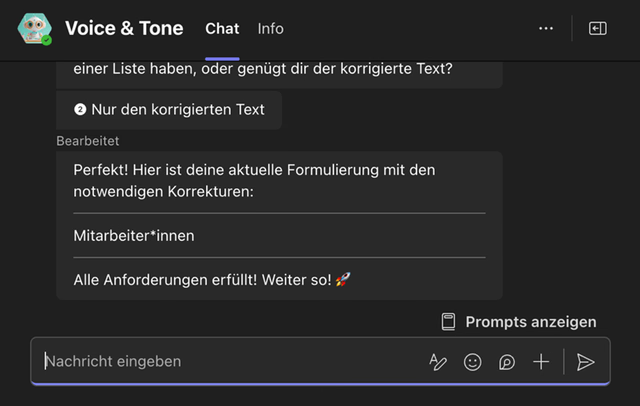
The Voice & Tone Bot
A good example of this is our Voice & Tone Bot. The guide was developed so that we don’t have to think about how to formulate every text we write in line with our brand. We lay down rules on how content should be formulated that also corresponds to our brand values and strikes the right tone in every communication. The idea was to convert a comprehensive voice & tone guide into an interactive assistant.
This reviews draft texts directly in Microsoft Teams and makes suggestions for improvement – always in line with our branding.
Instead of struggling through dry instructions, you can simply enter text and get immediate feedback: Is it friendly enough? Does the tone match the branding?
You have the feeling of having a charming proofreader at your side who not only points out mistakes, but also suggests the right wording with a wink. The bot is matter-of-fact, polite and has just the right amount of humour to make the work more enjoyable. Find out more here.
Out-of-office bot on the intranet
The next step was our absence bot – and this is where it got personal. It wasn’t just about information, but also about building trust.
Imagine someone standing in front of a huge bookshelf. There’s everything in there: holidays, overtime, sick notes, everything to do with their own absence. But instead of going to the trouble of looking for the right book, you want to ask someone – discreetly and without feeling incompetent. This is exactly the role of the bot. It’s like a friendly librarian who not only hands you the right book, but also marks the best pages. Through our mentors, we ensure that every bot communicates according to our values and guidelines.
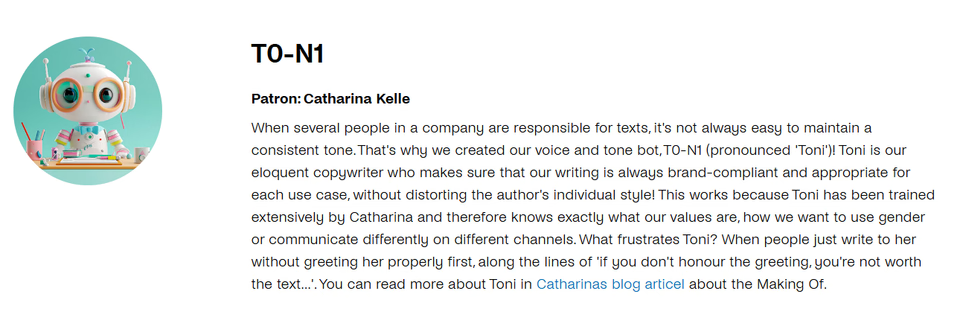
The assistant bot for absence Stevie Sloth – from project scoping to MVP
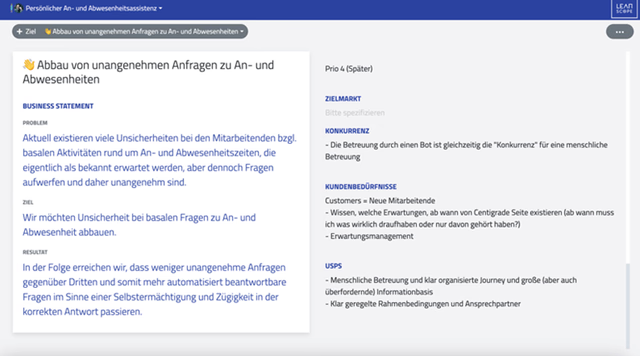
LeanScope and MVP
As with all our projects, we started with LeanScope. Originally, we wanted to develop a bot for onboarding. However, during scoping, the focus shifted to the problem of absences and became the MVP for the absence assistant. The uncertainty surrounding holiday planning and other absences was not just a problem during the trial period, but a user need for all employees.
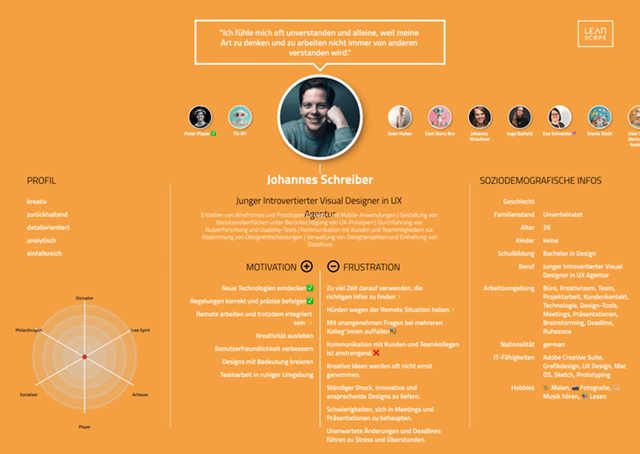
We developed a persona, Johannes Schreiber, which helped us to better understand the user perspective. Johannes is supposed to represent the typical new employee at Centigrade and was described by us as introverted and insecure. The topic of leave of absence during the probationary period in particular is a minefield full of stumbling blocks for him, as experience from other companies and other employees’ working models can be unsettling.
Qualitative User Research
Our interviews went into depth. We didn’t just want to find out facts, but also feelings. How does it feel to apply for a holiday? Is it a gentle breeze or a storm of uncertainty? We asked questions like:
- What experiences have users already had with chatbots?
- When and why do they prefer colleagues to chatbots?
- What role does trust play in the use of chatbots? What prevents them from trusting chatbots?
The stories about holiday requests were particularly interesting. Many reported insecurities that are often based on outdated assumptions – such as the idea that leave during the probationary period is taboo. Our aim was to find out how the bot can reduce these fears and become a trustworthy companion.
Main findings from the interviews:
1. Users need targeted support.
- The solution to a problem when it arises: Appropriate contact person, role-, topic-specific and individualised answers to the question(s), reliable information, guided process
- Encouraging feedback on the request Being able to reconcile spontaneity but also predictability through transparency, coordination in the background, who agrees, Time off is perceived as a disruptive factor
2. Users want to communicate at eye level
- Discuss problems with other new colleagues as they are in a similar situation
- Gain understanding for your own situation and support for the leave of absence
- Communicate in a calm, relaxed atmosphere
- Compare your own situation with the conventional solution
3. Users want to prove themselves during the trial period
- Trial period as a performance test also has an impact on secondary areas
- Do not want to leave a bad impression and show weakness
- Don’t want to be a burden on colleagues
- Be able to achieve goals yourself, prove to yourself what you can do
- Strengthening self-confidence
Additional findings
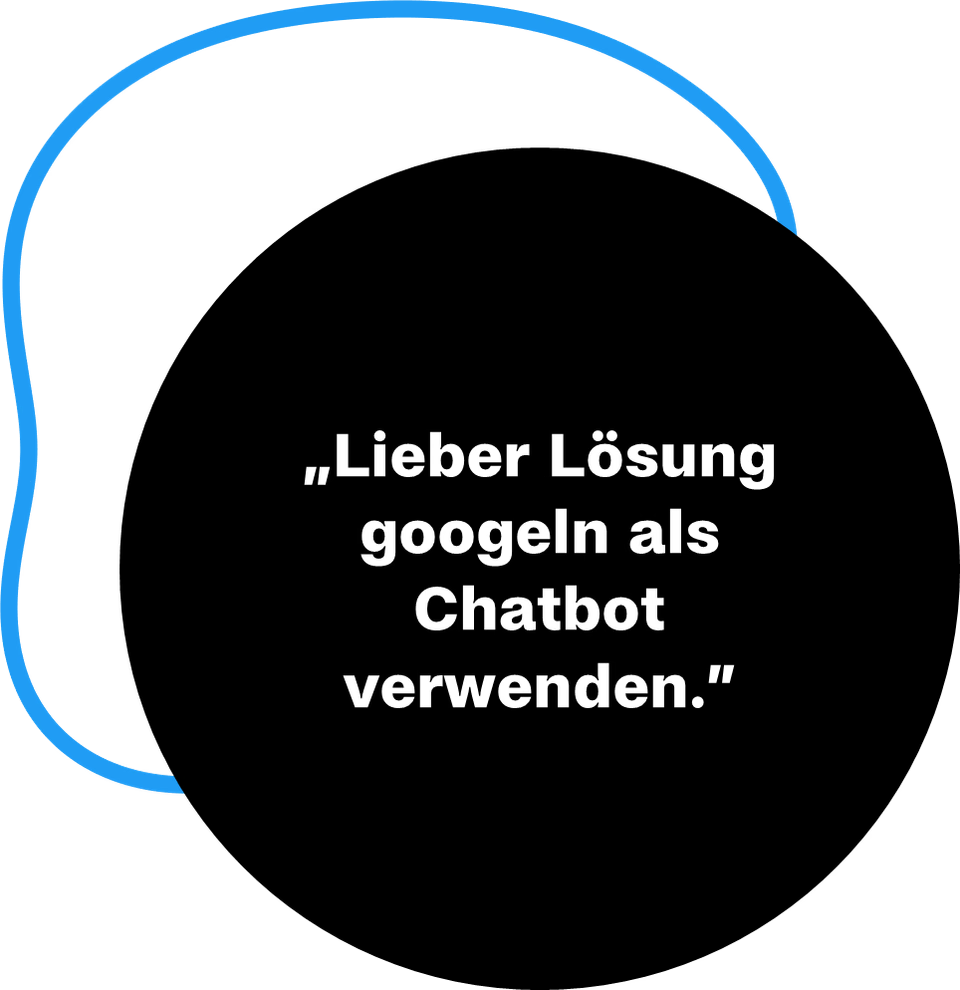
Respondents had mixed feelings about Chat GPT. On the one hand, the answers ‘felt intelligent’, on the other hand, the underlying facts first had to be checked. A source that they can check themselves would help here. Respondents’ trust in bots is also not as high as in humans. Here it is important to consider whether communication goes beyond simple facts or whether the participants would also communicate specific and individual wishes.
Conclusion
Information procurement as a human experience
When technology fails, there is often a bitter aftertaste. A bot that responds to the first question with a link to support comes across like a closed doorman who turns us away.
We want the opposite: a bot that behaves like a good host – attentive, friendly and always ready to help. It’s not about copying humanity, but about providing information in a form that feels human. The basics of the bot must be comprehensible to everyone and the sources must be verifiable.
What do we expect from a chat bot?
A chat bot is intended to provide relief in the right places. The aim is not to replace people, but to provide practical support that responds to the individual needs of users.
If bots act as social partners and provide reliable information in human language, they can not only make work processes easier, but also more human.
Bots (and conversational AI in general) and other digital products require good UX and, above all, UXR in order to meet the needs of users and offer added value.
And if the bot can’t help me with pure information in the situation I’m currently in, then I’ll just turn to my work colleague or a good friend!