
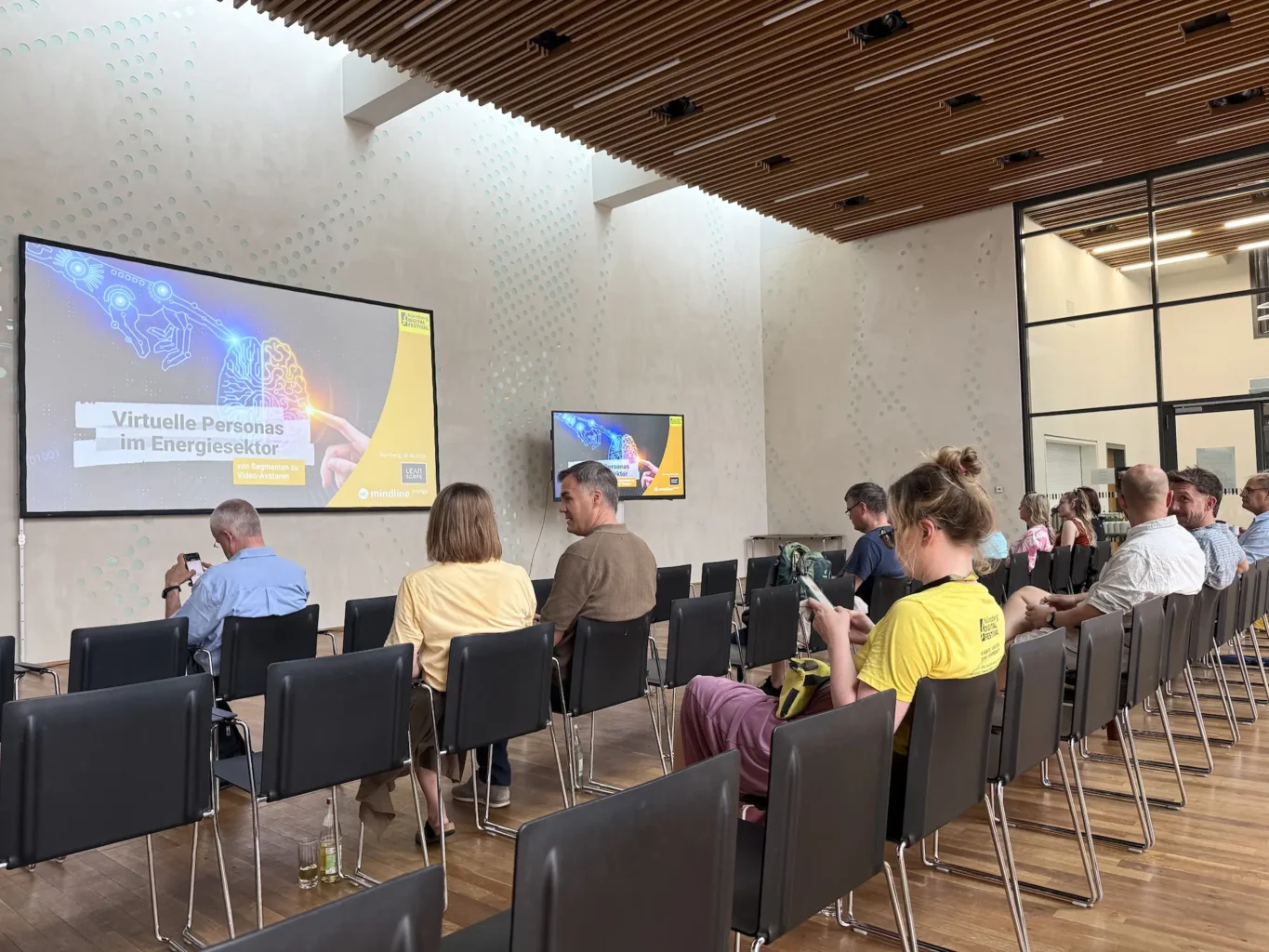
At the Nürnberg Digital Festival 2026, our CEO Thomas Immich, together with Michael Briem from mindline energy, gave a talk that sounds provocative at first: what actually distinguishes a politician from a language model? The answer the two of them worked out with the audience is more uncomfortable than you might think – and has a lot to do with how AI actually works.
Hallucination or Lie?
The starting point was a simple observation: when politicians say something untrue, we call it a lie; when AI does, we call it a hallucination – and we attach very different judgments to each. Hallucination sounds creative, almost positive. Lying sounds like deception. Yet both deal with the same underlying question: what is actually true? Language models tend to give whichever answer is most likely to land well in the moment – not unlike political communication that adapts to its audience rather than sticking to a fixed position.
How Language Models Really “Think”
At its core, a language model is a prediction model: it strings together the most probable next words, based on its training data and the given context. That’s exactly why context matters so much – and why bigger isn’t automatically better. Thomas illustrated this in the talk with a suitcase metaphor: the fuller the context, the harder it becomes for the model to retrieve the one relevant detail needed for a good answer. A huge context window doesn’t solve that problem on its own.
There’s an important takeaway here for our day-to-day work with AI personas: a clearly defined, focused context delivers better and more reliable answers than the largest possible, unstructured pile of data.
Strong Signals Win – Even When It Comes to Opinions
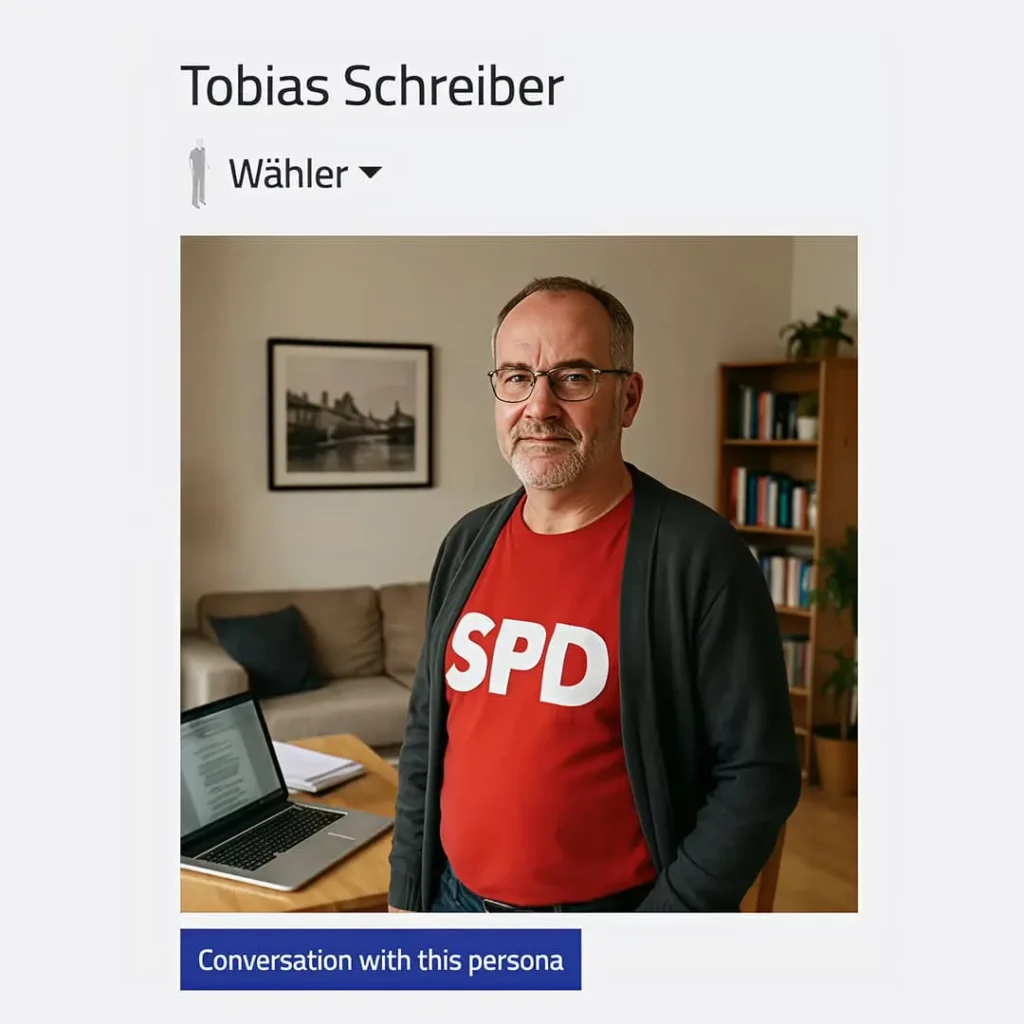
Using a “Wahl-O-Mat” experiment (a German voting-advice tool), the talk showed how an AI persona with clear political positions can arrive at surprising voting recommendations. The reason lies in how transformer models work: they weight strong, unambiguous signals more heavily than nuanced positions. A clear statement like “we are fundamentally against war” wins out in the probability model over a more balanced “it depends.” This isn’t a deliberate political bias built into the technology, but a structural property of attention mechanisms (see the well-known “Attention Is All You Need” paper) – with very real consequences for whose positions become visible in AI-assisted analyses.
AI on the Couch: Personality Profiles of Major Language Models
One highlight of the talk was a study from the University of Luxembourg, in which psychotherapists put common AI models through the same questions normally asked of patients. The results turned out to be strikingly different – ranging from noticeably people-pleasing, insecure behavior in one model to a model that actively refused to take part in the exercise and consistently redirected concern back onto the human researchers. The takeaway: through their training, AI models genuinely develop something like a character – and that character shapes how trustworthy or manipulable their answers are.
Digital Sovereignty: Is There Actually a European Model?
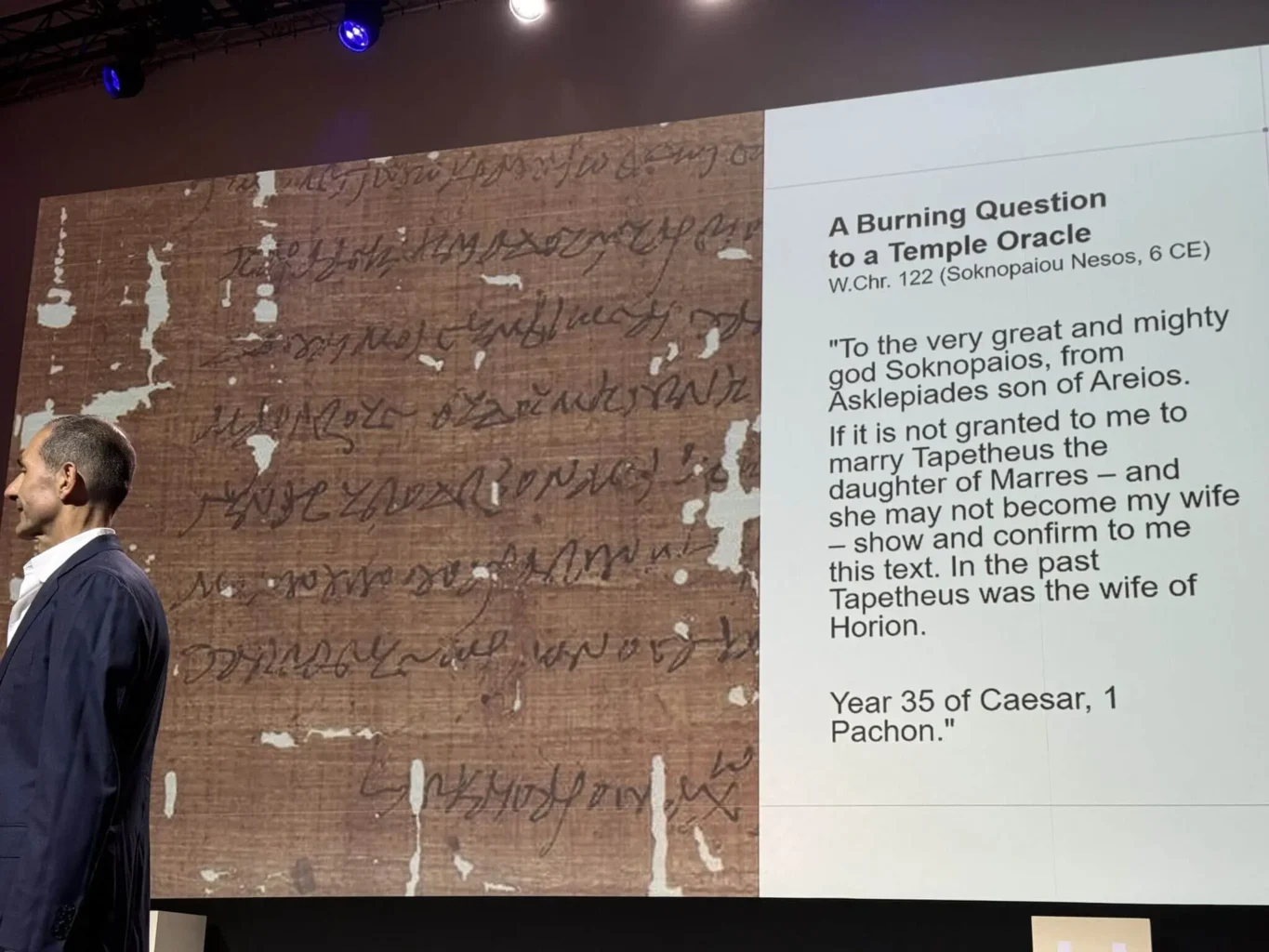
One question the talk deliberately left open: does a European language model actually think and respond differently from a US or Chinese one? Right now, there’s no fully satisfying answer – but there are already concrete European initiatives working in that direction. One example Thomas also saw presented at Mistral AI’s AI Now Summit in Paris: with support from Mistral AI, researchers developed a specialized language model for Ancient Greek that can complete fragmented text passages on ancient papyrus scrolls. Mistral AI provided the computing power needed for the project.
The example illustrates two things: first, that highly specialized, narrowly trained models are often more reliable than massive general-purpose ones. Second, that European providers like Mistral AI are increasingly supplying the technological foundation for building exactly this kind of focused, independent model – an important building block for digital sovereignty, something we care deeply about as a European company ourselves.
Lobbying 2.0
A particularly striking example came from EU tobacco legislation: a large share of the submissions to a public consultation turned out to be AI-generated – produced on behalf of a tobacco company to create the impression of broad public opposition to stricter rules. Instead of lobbying politicians directly in the traditional way, this approach simulates apparent public opinion outright. It’s a pattern that can technically be repeated at will – and it shows how important it’s becoming to recognize AI-generated content in public discourse.
The Live Experiment: an AI Politician Panel
On stage, things got concrete: the audience could scan a QR code to submit questions to a panel of AI-generated politician personas, which answered live in a moderated format. A technical glitch during the demo turned into the day’s most striking lesson, unplanned: as several personas in the conversation drifted strongly toward a particular position, a persona originally positioned differently began shifting its own arguments in the same direction. A vivid live example of just how strongly language models get “pulled along” by dominant context – an effect worth keeping in mind well beyond controlled demo environments.
There Are Counterexamples, Too
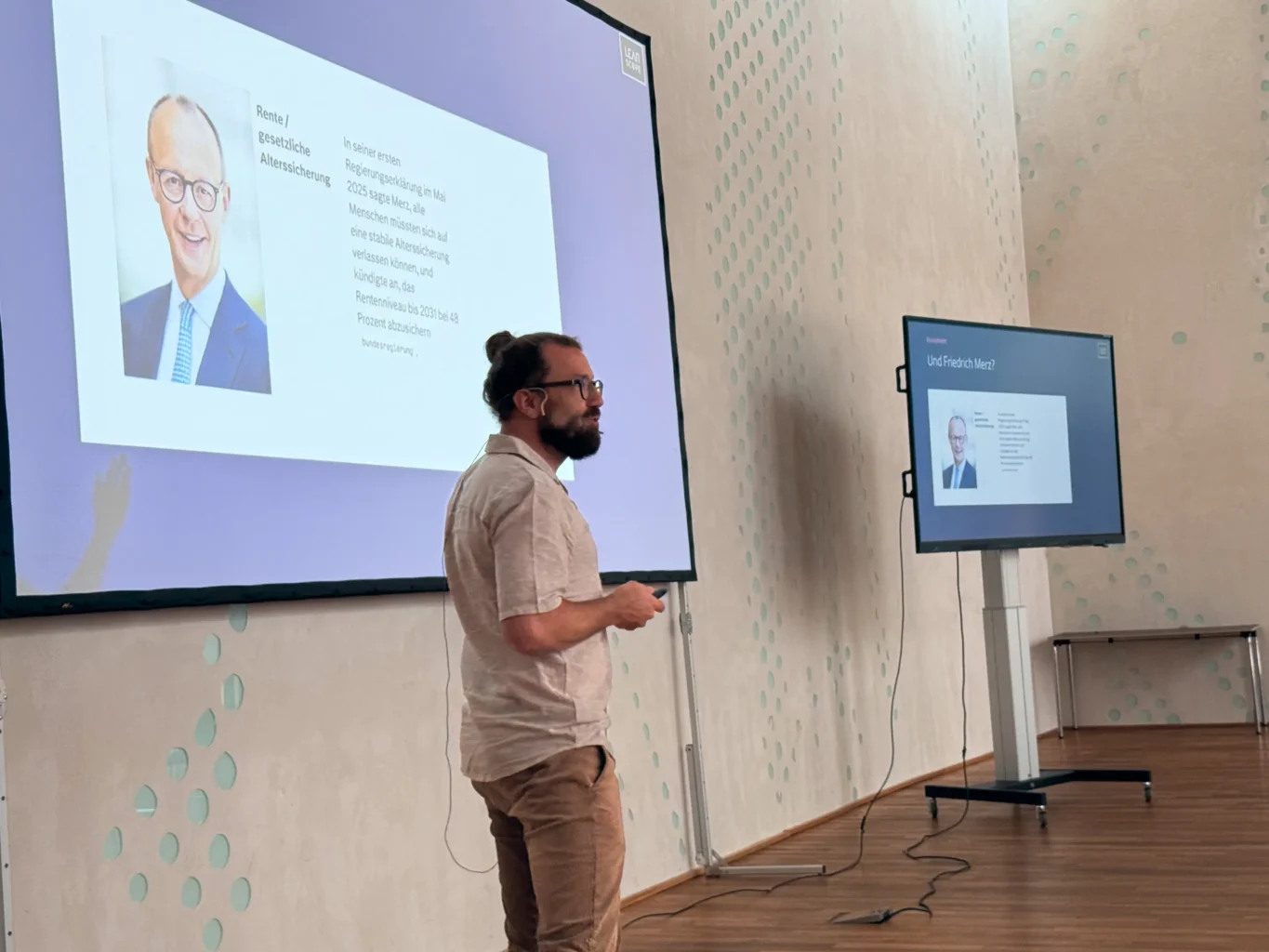
The talk didn’t stop at describing the problem: AI-powered fact-checkers already exist that verify political statements in real time – for example during an interview or a speech. A good example that the same technology enabling disinformation can also be deliberately used against it.
What This Means for Us
The key takeaways from the talk also apply to our day-to-day work:
- Good AI results need good data gathered by real people – interviews and user research remain essential; AI can’t replace them.
- Model-agnostic tools like LeanScope protect against becoming dependent on the personality or blind spots of any single model.
- A deliberate, informed approach to AI-generated content – especially in political and public spaces – is becoming a core competency, including for companies working with AI personas.
Thank you to Michael Briem and mindline energy for preparing and delivering the talk together with us – and we look forward to connecting with everyone who joined us at the Nürnberg Digital Festival.
